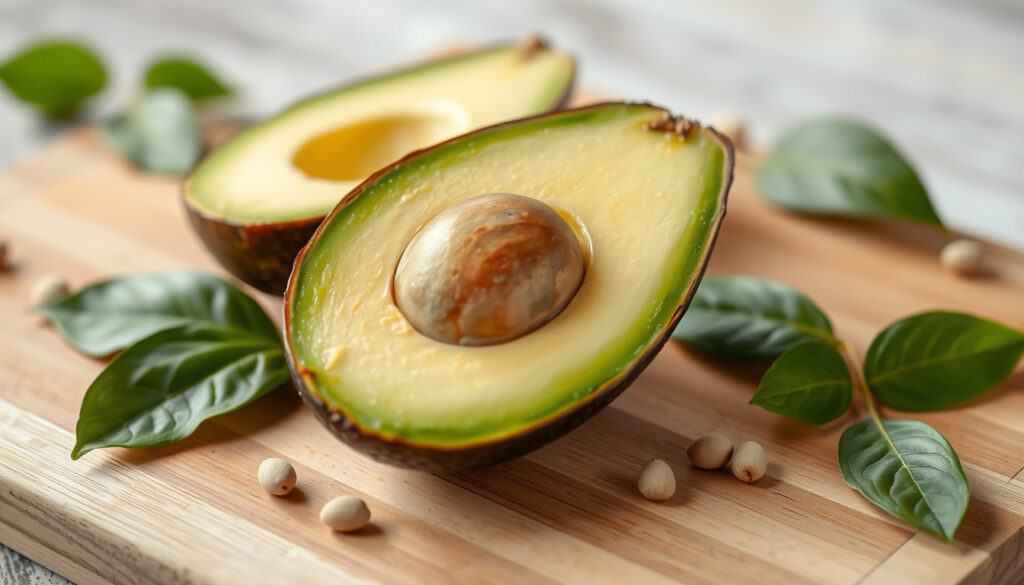
Is Avocado a Fruit? Classification and Health Facts
You’ve probably sliced an avocado for toast or guacamole without thinking twice about what it really is. But ask a botanist, and you’ll get a different answer than your cookbook suggests. This article unpacks how avocados are classified, what makes them unique among fruits, and where the health trade-offs live — so the next time you reach for one, you know exactly what you’re getting.
Botanical classification: Berry ·
Global production (2023): ~8 million tonnes ·
Leading producer: Mexico (29% of global harvest) ·
Fruit type: Climacteric (ripens after harvest)
Quick snapshot
- Avocado is a fruit – specifically a berry (UC Riverside Avocado Resource)
- Develops from a single ovary of the avocado flower (Encyclopaedia Britannica)
- Contains one large seed (USDA Plants Database)
- Often treated as a vegetable in savory dishes (Discover + Share)
- Common in salads, guacamole, and sandwiches (BBC Good Food)
- Mild flavor and creamy texture (Discover + Share)
- Rich in monounsaturated fat (Discover + Share)
- Good source of fiber, potassium, and vitamins (Harvard T.H. Chan School of Public Health)
- May support heart health and weight management (Harvard T.H. Chan School of Public Health)
- High in calories compared to most fruits (USDA FoodData Central)
- May trigger allergies in latex-sensitive individuals (AAAAI)
- Can interact with blood thinners (warfarin) due to vitamin K content (NHLBI)
Key characteristics of avocados:
| Attribute | Value |
|---|---|
| Botanical name | Persea americana (USDA Plants Database) |
| Fruit type | Berry (single-seeded) (UC Riverside) |
| Common culinary usage | Vegetable (savory) (Discover + Share) |
| Average weight per fruit | 150-250 g (content plan data) |
| Annual global production | ~8 million tonnes (2023) (Wikipedia) |
Is avocado a fruit or vegetable?
Botanical definition of fruit
- A fruit develops from the flower of a plant and contains seeds (Encyclopaedia Britannica).
- Avocados meet this definition: they grow from the avocado flower and contain a single large seed (UC Agriculture and Natural Resources).
The botanical test is straightforward: if it starts as a flower’s ovary and holds seeds, it’s a fruit. By that standard, avocados are unequivocally a fruit.
Why avocados are botanically a berry
- A berry is defined as a fleshy fruit without a stone, developing from a single ovary (Encyclopaedia Britannica).
- Avocados are classified as a single-seeded berry (Persea americana) (UC Riverside Avocado Resource).
This puts avocados in the same technical category as bananas and tomatoes — all are botanically berries, even though grocery stores stock them differently.
Culinary classification of avocado
- In culinary contexts, avocados are often treated as vegetables due to their savory flavor (Discover + Share).
- They are rarely used in sweet dishes, unlike most fruits (BBC Good Food).
The catch: what we call something in the kitchen doesn’t change what it is in the field. Avocados are fruits that pose as vegetables.
Are avocados the healthiest fruit?
Nutrient profile of avocado
- Avocados are rich in monounsaturated fat, fiber, potassium, and vitamins C, E, K, B6 (Harvard T.H. Chan School of Public Health).
- They contain 20 different vitamins and minerals per serving (content plan data).
No single fruit can claim the “healthiest” crown — benefits depend entirely on what your body needs. But avocados pack a dense combination of nutrients that few fruits match.
Comparison with other nutrient-dense fruits
- Compared to bananas, avocados have far less sugar and more fiber (Harvard T.H. Chan School of Public Health).
- They also supply more potassium per serving than bananas (NIH Office of Dietary Supplements).
The trade-off: avocados are calorie-dense (about 240 calories per medium fruit), so portion control matters for weight management.
Role of healthy fats in diet
- Monounsaturated fats are linked to heart health and reduced inflammation (American Heart Association).
- Avocados provide ~15g of monounsaturated fat per medium fruit (USDA FoodData Central).
Why do some doctors say not to eat avocados?
Potential downsides of avocado consumption
- Avocados are high in calories and fat, which may be a concern for weight management (Harvard T.H. Chan School of Public Health).
- One medium avocado contains roughly 240 calories — more than three times that of an apple (USDA FoodData Central).
The pattern: calorie density is the main downside, not the fat quality.
Allergies and intolerances
- Some individuals have latex-fruit syndrome and may react to avocado (AAAAI).
- Oral allergy syndrome can also cause cross-reactivity with avocado (Mayo Clinic).
For a small percentage of people, eating avocado triggers uncomfortable reactions — though for most, it’s safe.
Medication interactions
- Avocados contain vitamin K, which can interfere with blood thinners like warfarin (NHLBI).
- Consistent intake rather than sporadic large amounts is recommended for patients on these medications (Mayo Clinic).
High calorie density
- Avocados are more calorie-dense than almost any other fruit (USDA FoodData Central).
- For someone eating a calorie-restricted diet, a single avocado can cover 12% of daily energy needs.
The implication: avocados are not a “free food” — they work best as a replacement for less healthy fats, not an addition.
Which is healthier, banana or avocado?
Both fruits bring different strengths. Here’s how they stack up head-to-head:
| Metric | Avocado (medium, ~150g) | Banana (medium, ~118g) |
|---|---|---|
| Calories | 240 (USDA) | 105 (USDA) |
| Carbohydrates | 13g | 27g |
| Sugar | ~2g | ~14g |
| Fiber | 10g | 3g |
| Fat | 22g (mostly monounsaturated) | 0.4g |
| Potassium | 975mg (NIH) | 422mg |
| Vitamin C | 12mg | 10mg |
| Vitamin K | 28µg (USDA) | 0.5µg |
The pattern: both fruits offer unique benefits; the choice depends on individual health goals.
Is an avocado a berry?
Definition of a berry in botany
- A berry is a fleshy fruit without a stone, developed from a single ovary (Encyclopaedia Britannica).
- Examples of true berries: bananas, grapes, tomatoes — not strawberries or raspberries.
How avocados meet berry criteria
- Avocados are a single-seeded berry (Persea americana) (UC Riverside Avocado Resource).
- They develop from a single ovary and have a fleshy pericarp (UC Agriculture and Natural Resources).
Differences from common berries like blueberries
- Common berries (blueberries, cranberries) have many seeds; avocados have one large seed.
- Despite the single seed, the avocado’s fruit structure matches the botanical definition of a berry (Encyclopaedia Britannica).
The upshot: avocados are berries in a technical sense, even if they look nothing like the berries you buy in a pint.
Confirmed facts
- Avocado is botanically a fruit and a berry (UC Riverside)
- Avocados contain healthy monounsaturated fats (Harvard T.H. Chan School)
What’s unclear
- Whether avocado consumption directly leads to weight gain (depends on overall diet)
- Optimal daily serving size for maximum health benefit
- Whether avocados are higher in calories compared to most fruits (depends on portion and fruit selection)
“Avocado is technically a fruit, with healthy unsaturated fats — but it’s also one of the highest-calorie fruits you can eat.”
— Harvard Health Publishing (Harvard Health)
“The avocado fruit is a large berry containing a single seed.”
— Wikipedia: Avocado (Wikipedia)
“Avocados are rich in monounsaturated fat, which can help lower bad cholesterol.”
— BBC Good Food (BBC Good Food)
For the average eater, the evidence is clear: avocados are nutritionally dense and support heart health when eaten in moderation. The decision comes down to personal health goals. For someone watching calories, replacing butter with avocado is a win. For someone on blood thinners, consistency matters more than abstinence.
Wer sich für die botanische Einordnung der Avocado interessiert, findet dort eine ausführliche Erklärung, warum die Avocado botanisch als Beere gilt.
Frequently asked questions
What is the botanical classification of avocado?
Avocado (Persea americana) is a fruit and specifically a single-seeded berry, part of the laurel family (USDA).
How many varieties of avocado are there?
Three principal botanical races exist: Mexican, Guatemalan, and West Indian (UC ANR). The Hass avocado is the most commercially popular variety, derived from the Guatemalan race.
Is avocado considered a fruit in cooking?
No — in the kitchen, avocado is almost always treated as a vegetable due to its savory flavor and texture (Discover + Share).
Why is avocado called an alligator pear?
Early English traders called it “alligator pear” because of its rough, green skin and pear-like shape — though the name has faded from common use (Wikipedia).
What are the main types of avocado?
The two main commercial types are Hass (thick, pebbled skin) and Fuerte (smooth, thinner skin). Many regional varieties exist (UC ANR).
Is a cucumber a fruit?
Yes, botanically cucumbers are fruits — they develop from flowers and contain seeds. Like avocados, they are often cooked as vegetables.
Is tomato a fruit or vegetable?
Botanically, a tomato is a fruit (and a berry). In 1893 the U.S. Supreme Court ruled it a vegetable for tariff purposes (NPR).
Is carrot a fruit or vegetable?
Carrots are roots, not fruits — they do not develop from flowers or contain seeds. They are vegetables in all contexts.
More related posts
 Alvin and the Chipmunks 2007 – Plot, Cast, Box Office Guide
 Voting Rights Act of 1965: Summary and Impact
 Best Ropa Vieja Canaria Near Me: Canarian vs Cuban Guide
 Liverpool vs Bournemouth Lineups: Salah Starts, Ngumoha on Bench
 Liga MX Femenil Standings 2025/26: Live Table & Top Teams
 Adopt a Dog Near Me in Ireland: Rescue Shelters Guide
 Timberwolves vs Lakers Timeline: 2025-26 Season Games and Results
 Warriors vs Jazz Player Stats: Curry Scores 31 (Jan 4, 2026)