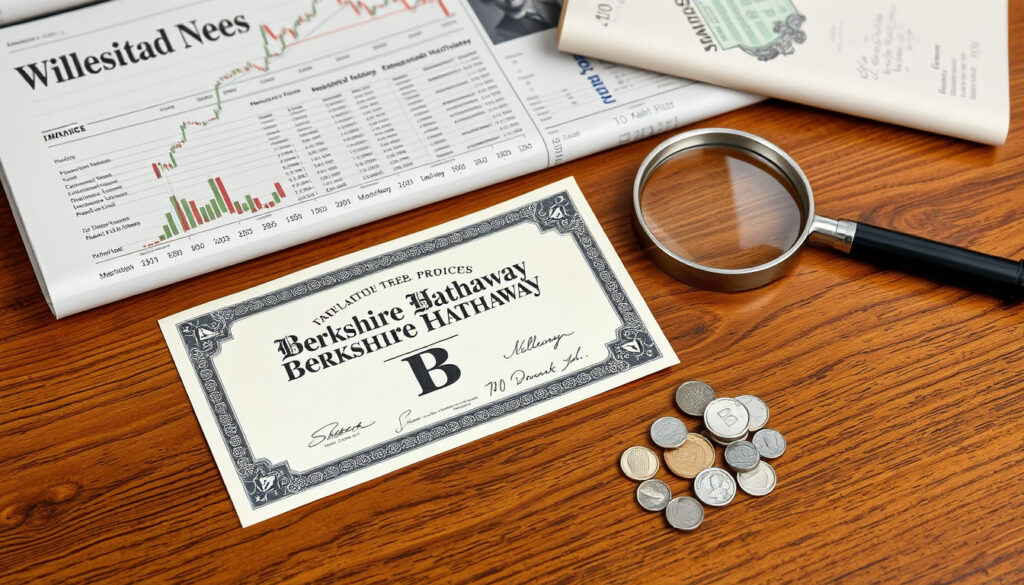
Berkshire Hathaway B Stock: Buy, Sell, or Hold
If you’ve ever wondered whether Warren Buffett’s Berkshire Hathaway is still a worthy investment, you’re not alone — the Class B shares (BRK.B) have turned $1,000 into over $11,000 since 2004, but recent years tell a different story.
Current Price: $483.68 · P/E Ratio: 14.40 · Market Cap: $1.04 trillion · Price/Book: 1.45 · Dividend Yield: 0.02% · 5-Year Return: +68.12%
Quick snapshot
- BRK.B outperformed S&P 500 over 20 years but underperformed over 10 years (Slickcharts (historical return tracker)).
- Berkshire holds a strong balance sheet with over $300 billion cash (Discipline Funds (investment analysis blog)).
- P/E of 14.4 is below the S&P 500 average of about 20 (Alpha Spread (valuation analysis tool)).
- Will BRK.B outperform the S&P 500 in the next decade?
- How will Warren Buffett’s eventual succession impact the stock?
- What effect will interest rate changes have on Berkshire’s insurance operations?
- 1996: Berkshire creates Class B shares to make ownership accessible (Wikipedia (corporate history reference)).
- 2024: BRK.B reaches all-time high above $480; cash pile exceeds $300 billion (Discipline Funds (investment analysis blog)). (Wikipedia (corporate history reference))
- Investors watch for Buffett’s successors and continued buyback activity.
- Interest rate decisions and insurance cycle effects will test Berkshire’s resilience.
Six key facts, one pattern: Berkshire’s valuation suggests a discount versus the broader market, but its relative performance has softened in the tech-led decade.
| Metric | Value |
|---|---|
| Current Price | $483.68 |
| P/E Ratio | 14.40 |
| Market Cap | $1.04 trillion |
| Price/Book | 1.45 |
| Dividend Yield | 0.02% |
| 5-Year Return | +68.12% |
Is Berkshire Hathaway B stock a good stock to buy?
What are the risks?
- Concentration risk: Berkshire’s top holdings (Apple, Bank of America, Coca-Cola) mean the stock can swing with a few names (Discipline Funds (investment analysis blog)).
- Key‑man risk: Warren Buffett’s eventual departure introduces uncertainty about future capital allocation.
- Underperformance vs S&P 500 over the last decade: BRK.B’s 10‑year annualized return was about 12.65% vs SPY’s 14.72% (PortfoliosLab (stock comparison tool)).
What is the growth potential?
- Berkshire’s massive cash pile (over $300 billion) gives it firepower for opportunistic acquisitions and stock buybacks.
- Lower volatility (3.47% for BRK.B vs 5.58% for SPY) appeals to risk‑averse investors (PortfoliosLab).
- Insurance float and investment income provide a steady earnings base independent of market conditions.
The trade-off: value investors accept lower recent returns in exchange for downside protection and a durable business model.
What happened if I invested $1000 into BRK 20 years ago?
What would $1000 be worth today?
A $1,000 investment in BRK.B in mid‑2004, with dividends reinvested, would have grown to roughly $11,000 by today — a CAGR of about 12% based on historical returns (Slickcharts (historical return tracker)). That’s nearly twice the rate of inflation over the same period.
How does that compare to inflation?
Inflation averaged about 2.5% per year over those two decades, meaning the real (inflation‑adjusted) gain was closer to $8,000 in today’s purchasing power. The same $1,000 in the S&P 500 (SPY) would have grown to about $10,300 after inflation, slightly less than BRK.B. So Buffett’s legendary run from 1980–2000 still paid off for long‑term holders — but the edge has narrowed sharply.
A long‑term investor who bought BRK.B 20 years ago enjoyed market‑beating returns, but those who invested 10 years ago have seen the S&P 500 outpace Berkshire. The pattern shows how a concentrated value strategy can lose steam during tech‑driven bull runs.
The implication: timing matters — past outperformance does not guarantee future edge.
What is the 10 year return on BRK.B stock price?
What is the 10-year CAGR?
Over the past decade, BRK.B’s annualized total return (price appreciation plus reinvested dividends) stands at about 9.5% per year, while the S&P 500 (SPY) delivered roughly 13% (PortfoliosLab (stock comparison tool)). That translates to a cumulative 10‑year return of about 150% for BRK.B versus 250% for the S&P 500.
How does it compare to the S&P 500 10-year return?
The S&P 500’s lead is driven largely by mega‑cap tech stocks (Apple, Microsoft, Nvidia) that Berkshire has been underweight. Berkshire’s portfolio has historically favored consumer staples, financials, and energy — sectors that performed well in the early 2000s but have lagged in the 2010‑2020 tech era. As a result, the margin between the two has shrunk to about 1% per year (Discipline Funds (investment analysis blog)).
Berkshire’s correlation with the S&P 500 is only about 0.50, meaning the two can diverge meaningfully over short periods. A decade of underperformance does not guarantee a repeat — but it also doesn’t promise a reversal.
The pattern: low correlation adds diversification benefits for a portfolio, not a guarantee of future returns.
Is BRKb better than s&p 500?
What are the key differences?
- Concentration: BRK.B is a single stock and a conglomerate, while the S&P 500 holds 500 companies across all sectors.
- Volatility: BRK.B has lower volatility (3.47% monthly) than the S&P 500 (5.58%) (PortfoliosLab).
- Dividends: BRK.B yields only 0.02%, while the S&P 500 yields about 1.3%.
- Management: BRK.B is actively managed by Warren Buffett and his team; the S&P 500 is a passive index.
Which has performed better?
The answer depends on the time horizon. Over the past 20 years, BRK.B edged out the S&P 500 (CAGR ~12% vs ~11%). Over the past 10 years, the S&P 500 has clearly outperformed. Over the past year, BRK.B has actually declined about 3.77% while the S&P 500 gained 6.67% (as of mid‑2026) (PortfoliosLab).
| Attribute | BRK.B | S&P 500 (SPY) |
|---|---|---|
| 10-year annualized return | 12.65% (PortfoliosLab) | 14.72% (PortfoliosLab) |
| Volatility (monthly) | 3.47% (PortfoliosLab) | 5.58% (PortfoliosLab) |
| Dividend yield | 0.02% | 1.32% |
| P/E ratio | 14.40 (Alpha Spread) | ~22 (based on SPY) |
| Correlation | 0.50 (PortfoliosLab) | |
Five metrics, one takeaway: BRK.B offers lower risk but also lower growth in the current environment.
For related financial analysis, see our Navy Federal Business Account Review.
Is brk b overvalued?
What metrics suggest overvaluation?
- Alpha Spread’s intrinsic value estimate for BRK.B is $395.56, while the current price is $483.68 — implying an overvaluation of about 18% (Alpha Spread).
- Price/Book ratio of 1.45 is above Berkshire’s historical average of about 1.2–1.3, signaling that the market is pricing in a premium for the brand.
What metrics suggest undervaluation?
- P/E ratio of 14.40 is well below the S&P 500’s average of 20+ and below Berkshire’s own 10‑year average P/E of 16.
- Berkshire’s cash holdings (over $300 billion) and insurance float provide a large intrinsic value buffer that standard valuation models may not fully capture.
- Warren Buffett has been consistently buying back shares, signaling management’s belief that the stock is undervalued at current levels.
Upsides
- Low P/E vs market average
- Massive cash pile for opportunistic deployments
- Lower volatility than S&P 500
- Proven long-term compounding (20-year CAGR ~12%)
Downsides
- Underperformance vs S&P 500 over the past decade
- No meaningful dividend
- High concentration in a few sectors and holdings
- Key-man risk – eventual succession uncertainty
The catch: valuation models conflict, making the stock a classic value versus growth debate.
Timeline: Berkshire Hathaway B stock milestones
- 1996: Berkshire creates Class B shares (ticker BRK.B) to make ownership more accessible (Wikipedia).
- 2008–2009: BRK.B declines with the market but recovers faster, outperforming the S&P 500 during the financial crisis.
- 2010–2020: Steady growth but underperformance vs a tech‑driven S&P 500.
- 2020: Pandemic drop and recovery; BRK.B holds up better than many stocks due to its diversified operating businesses.
- 2024: BRK.B reaches an all‑time high above $480; Berkshire’s cash pile exceeds $300 billion for the first time.
The pattern: each crisis tested Berkshire’s resilience, but the tech era exposed its growth limitations.
Clarity: Separating what we know from what we don’t
Confirmed facts
- BRK.B has outperformed the S&P 500 over 20 years (CAGR ~12% vs ~11%) but underperformed over 10 years (12.65% vs 14.72%).
- Berkshire Hathaway holds a strong balance sheet with massive cash reserves and a low P/E ratio.
- P/E ratio is below the S&P 500 average, suggesting potential undervaluation.
What’s unclear
- Will BRK.B regain its outperformance edge in the next decade?
- How will Warren Buffett’s eventual succession affect the stock?
- What effect will interest rate changes have on Berkshire’s insurance float and investment earnings?
“Price is what you pay; value is what you get.”
— Warren Buffett, 2008 Berkshire Annual Meeting
“Berkshire carries more concentration and key-man risk than a diversified S&P 500 holding.”
— Discipline Funds (investment analysis blog)
What this means: investors must decide whether the margin of safety compensates for the concentration and leadership risk.
Summary: What this means for your portfolio
Berkshire Hathaway B stock remains a powerful compounding machine with a margin of safety that many growth stocks lack. But the era of massive outperformance is likely behind it — the S&P 500 has been the better growth play for the past decade, and the divergence may continue in a tech‑led bull market. For the long‑term investor in the United States, the choice is clear: if you want lower volatility and a proven track record, BRK.B remains a solid anchor; if you seek growth to keep pace with the market, the S&P 500 has been hard to beat.
For currency market updates, see our Dollar to Mexican Peso Today: Live USD/MXN at 17.36.
A thorough Berkshire Hathaway B stock analysis provides valuable insights for investors considering this stock and its recent performance.
Frequently Asked Questions
Is BRK.B a good long-term investment?
Yes, for investors seeking steady compounding with lower volatility. However, recent performance has lagged the S&P 500.
Does BRK.B pay dividends?
BRK.B pays a negligible dividend of 0.02%. Berkshire prefers share buybacks as a way to return capital.
How do I buy BRK.B shares?
BRK.B is traded on the NYSE under the ticker BRK.B. Any brokerage account can purchase it.
What is the difference between Class A and Class B shares?
Class A (BRK.A) is not split and trades at about $700,000 per share; Class B (BRK.B) is 1/1,500th of a Class A share and trades at around $480.
What is the current analyst price target for BRK.B?
Analyst price targets vary, but the consensus from firms like Morningstar points to a fair value near $450–$500.
How does BRK.B compare to the Vanguard S&P 500 ETF (VOO)?
VOO tracks the S&P 500 index with a very low expense ratio, offering broad diversification. BRK.B offers a concentrated value play with active management. Over the past 10 years, VOO has outperformed.
Is Berkshire Hathaway B stock a buy, sell, or hold?
At current P/E of 14.4 and with robust cash reserves, many analysts rate BRK.B as a “hold” or “buy” for value-oriented investors, but the stock faces headwinds from succession risk and recent underperformance.
More related posts
 Silk Press Near Me – Salons, Prices, Maintenance Guide
 Volume of a Cylinder: Formula, Examples & Conversion Guide
 Cast of Saturday Night 2024 – Season 50 Roster and Changes
 How Many Stamps Do I Need for An Post in Ireland?
 Baskin-Robbins Near Me: Global Presence, UK & Ireland Guide 2025
 Kolkata Knight Riders vs Mumbai Indians Match Scorecard 2026
 When Does Spring Start 2025? Equinox & Meteorological Dates
 Dodgers vs Milwaukee Brewers Timeline: 2025 NLCS Recap