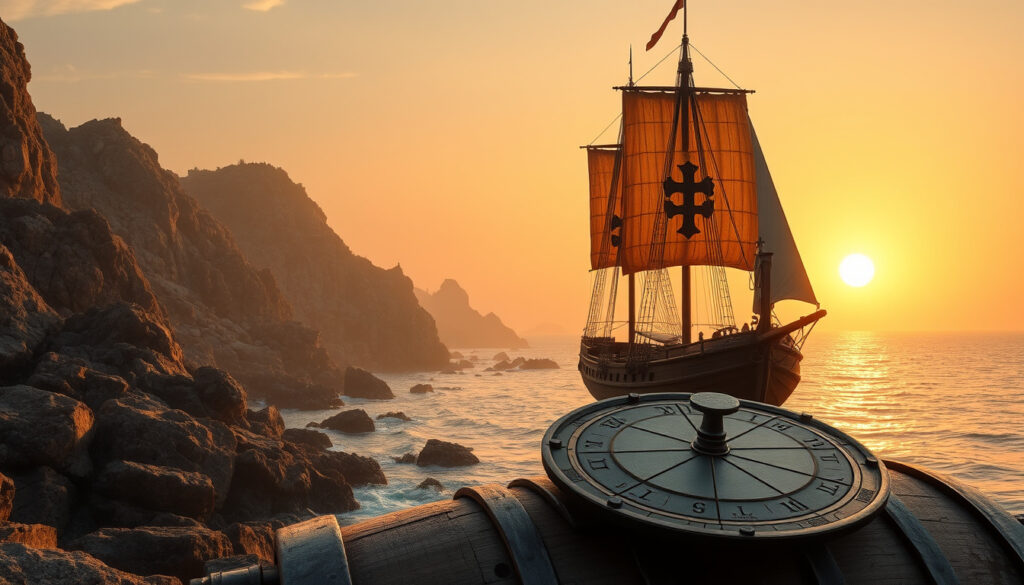
Prince Henry the Navigator: Biography and Legacy
Few historical figures carry a nickname as grand—and as misleading—as Prince Henry the Navigator, who never actually sailed on a major voyage of discovery. Yet this Portuguese prince, who stayed ashore while his ships pushed south, became the driving force behind Europe’s first great wave of Atlantic exploration.
Born: 4 March 1394, Porto, Portugal ·
Died: 13 December 1460, Sagres, Portugal ·
Known for: Patronage of early Portuguese exploration ·
Title: Infante of Portugal, Duke of Viseu ·
Key achievement: Initiated the Age of Discovery for Portugal
Quick snapshot
- Born 4 March 1394 in Porto, Portugal (Encyclopaedia Britannica)
- Never personally sailed on exploration voyages (Biography.com)
- Sponsored expeditions that reached Cape Bojador in 1434 (EBSCO Research Starters)
- Died 13 December 1460 in Sagres (Encyclopaedia Britannica)
- Whether Henry personally attended a “school of navigation” at Sagres (EBSCO Research Starters)
- Exact location and nature of the Sagres school (EBSCO Research Starters)
- Whether he ever sailed farther than Ceuta (Encyclopaedia Britannica summary)
- Whether he personally designed or innovated the caravel (EBSCO Research Starters)
- The exact number of expeditions he funded and his level of control over routes (EBSCO Research Starters)
- 1415: Ceuta captured (Encyclopaedia Britannica summary)
- 1419: Madeira discovered (Encyclopaedia Britannica summary)
- 1434: Cape Bojador rounded (EBSCO Research Starters)
- 1460: Henry dies (Encyclopaedia Britannica)
- Expeditions continued after his death, leading to Vasco da Gama’s voyage to India (Wikipedia)
- Portuguese slave trade expanded under his sponsorship (Biography.com)
Six key facts, one pattern: Prince Henry was a master organizer, not a sailor, yet his patronage reshaped the world.
| Attribute | Detail |
|---|---|
| Full Name | Infante Henrique of Portugal, Duke of Viseu |
| Born | 4 March 1394, Porto, Portugal |
| Died | 13 December 1460, Sagres, Portugal |
| Nationality | Portuguese |
| Known For | Patronage of exploration |
| Major Expeditions | Madeira, Azores, Cape Bojador, West African coast |
What Was Prince Henry the Navigator Famous For?
Patron of Exploration
Prince Henry is best known as the sponsor of Portuguese exploration along the African coast. Unlike later explorers, he never set foot on a voyage ship. Instead, he used his wealth and position as Grand Master of the Order of Christ to fund expeditions. The Encyclopaedia Britannica summary notes that the Order of Christ provided much of the money for these voyages.
- He financed the first systematic exploration of the West African coast.
- His patronage led to the discovery of Madeira (1419) and the Azores (1427).
- He supported the development of the caravel, a ship that could sail closer to the wind.
The catch: Henry’s role as a patron has been romanticized. Modern scholarship, as EBSCO Research Starters points out, questions whether he was a systematic promoter of exploration or a major innovator in navigation. The reality is more nuanced—he was a capable administrator who backed projects that others carried out.
Founding the School of Navigation at Sagres
Legend says Henry established a school of navigation at Sagres, gathering astronomers, cartographers, and shipbuilders. The truth is hazier. EBSCO Research Starters notes that the exact nature of the Sagres school is unclear. What is known: Henry maintained a court at Sagres, and his patronage attracted skilled navigators and instrument makers. The caravel’s design was refined there, and improved maps were produced.
Henry’s Sagres operation was more a workshop than a university, but it was the epicenter of early Portuguese maritime innovation.
Sponsorship of the Caravel
The caravel transformed Atlantic exploration. Small, fast, and able to sail into the wind, it allowed Portuguese ships to return from African voyages more reliably. Encyclopaedia Britannica summary credits Henry’s patronage with contributing to the caravel’s development. The implication: without this ship, the long voyages down the African coast would have been far riskier.
Why Is Prince Henry Called the Navigator?
The Origin of the Nickname
The nickname “Henry the Navigator” was applied posthumously by 19th-century historians. Britannica Kids explains that he was called “Navigator” because of the discoveries he inspired, not because he personally navigated. The term stuck, and today it’s the name most people know.
Misconceptions About His Own Travels
It’s a common mistake to think Henry sailed himself. In fact, Biography.com states plainly: “He was not actually a sailor or navigator himself.” He did participate in the conquest of Ceuta in 1415, but that was a military campaign, not a voyage of discovery. The paradox: a man who stayed on land became the symbol of ocean exploration.
Calling Henry a “navigator” is like calling a film producer a “movie star.” He made the voyages possible, but others sailed them.
What this means: the nickname is a monument to his organizational legacy, not his seafaring skill.
What Discoveries and Trade Routes Did Prince Henry Sponsor?
Exploration of the African Coast
Under Henry’s patronage, Portuguese ships pushed south along the West African coast. The rounding of Cape Bojador in 1434 by Gil Eanes was a major breakthrough—previous sailors had feared the currents and winds beyond that point. EBSCO Research Starters calls it a milestone. By the 1440s, ships had reached present-day Mauritania and Senegal.
- 1434: Cape Bojador rounded (EBSCO Research Starters)
- 1441: First cargo of African slaves brought to Portugal (Biography.com)
- 1444: Regular slave trading begins under Henry’s sponsorship (Encyclopaedia Britannica summary)
The Cape of Good Hope and Beyond
Henry did not live to see the Cape of Good Hope rounded. That would happen in 1488, 28 years after his death. He also did not achieve the sea route to India—Vasco da Gama reached it in 1498. But the stepping stones he funded made those later triumphs possible. The trade-off: his focus on the African coast delayed the push to India, but it established a lucrative West African trade in gold, ivory, and slaves.
Atlantic Islands: Madeira, Azores, Cape Verde
Henry’s sponsorship led to the discovery and colonization of key Atlantic islands. Encyclopaedia Britannica summary confirms that expeditions under his patronage discovered Madeira (1419) and the Azores (1427). Cape Verde was reached in the 1450s. These islands became vital bases for further exploration and sugar plantations.
The Atlantic islands were the first Portuguese colonies, and the sugar and slave trades that developed there set a pattern for centuries of European colonialism.
The implication: Henry’s island strategy created a permanent Atlantic footprint for Portugal.
What Happened to Prince Henry the Navigator?
Later Years and Death
Henry spent his final years at Sagres, continuing to oversee expeditions. He died on 13 December 1460 in Vila do Infante near Sagres, according to Encyclopaedia Britannica (Wikipedia lists a closely related location, Vila do Bispo). He never married and had no legitimate children. He is buried in the Monastery of Batalha.
Legacy After His Passing
His death did not end Portuguese exploration. The voyages continued under King Afonso V, and by 1488 Bartolomeu Dias had rounded the Cape of Good Hope. Wikipedia notes that Henry is often credited as one of the main initiators of the Age of Discovery. The pattern: his organizational genius outlived him.
The pattern: Henry’s death was not an end but a handoff, with his methods institutionalised by the crown.
What Are Some Interesting Facts About Prince Henry the Navigator?
Personal Life and Character
- He was the third surviving son of King John I of Portugal and Philippa of Lancaster (Encyclopaedia Britannica).
- He was a key figure in the capture of Ceuta in 1415 (Encyclopaedia Britannica summary).
- He never married, and had no legitimate children (Encyclopaedia Britannica).
- He served as governor of Ceuta and later of the Algarve (Encyclopaedia Britannica summary).
Cultural and Historical Impact
Henry’s legacy is a mix of achievement and controversy. He sponsored the first African slave raids in the 1440s, making him an early figure in the Atlantic slave trade. Biography.com notes that he is associated with the origin of the Atlantic enslaved people trade. The Sagres school is often romanticized; its exact nature is debated. Yet the scale of his impact is undeniable: he helped launch the Age of Discovery.
Timeline of Prince Henry’s Life and Expeditions
- 1394 – Prince Henry born in Porto, Portugal (Encyclopaedia Britannica)
- 1415 – Participates in the conquest of Ceuta, North Africa (Encyclopaedia Britannica summary)
- 1419 – Expeditions under his patronage discover Madeira (Encyclopaedia Britannica summary)
- 1427 – Portuguese ships reach the Azores (Encyclopaedia Britannica summary)
- 1434 – Gil Eanes rounds Cape Bojador (EBSCO Research Starters)
- 1441 – First cargo of African slaves brought to Portugal (Biography.com)
- 1444 – Regular slave trading begins under Henry’s sponsorship (Encyclopaedia Britannica summary)
- 1460 – Prince Henry dies in Sagres (Encyclopaedia Britannica)
The pattern: each milestone built on the last, creating a cumulative push that outlived its patron.
Confirmed facts
- Born 4 March 1394 in Porto, Portugal (Encyclopaedia Britannica)
- Died 13 December 1460 in Sagres (Encyclopaedia Britannica)
- Sponsored voyages along the African coast (Encyclopaedia Britannica summary)
- Never married, no legitimate children (Encyclopaedia Britannica)
- Key figure in early Portuguese slave trade (Biography.com)
What’s unclear
- Whether he personally attended the Sagres school or taught navigation (EBSCO Research Starters)
- Exact location and nature of the “School of Navigation” at Sagres (EBSCO Research Starters)
- Whether he ever sailed farther than Ceuta (Encyclopaedia Britannica summary)
- Whether he personally designed or innovated the caravel (EBSCO Research Starters)
- The exact number of expeditions he funded and his level of control over routes (EBSCO Research Starters)
“Henry’s role was that of a patron, not a pioneer. He organized and funded the voyages, but he did not sail on them.”
— C. R. Boxer, historian of Portuguese maritime empire
“It is our duty to explore the ocean and bring back knowledge of the lands beyond.”
— Attributed to Prince Henry, recorded in biographies
Prince Henry the Navigator never sailed the seas he helped open, but his sponsorship of exploration transformed the Atlantic world. The trade routes he funded brought gold, slaves, and new lands to Portugal—and set in motion a colonial system that reshaped Africa, Europe, and the Americas. For modern readers, the choice is clear: acknowledge both the achievements and the moral costs, or risk repeating the mistakes of the past.
newadvent.org, enchantedlearning.com, encyclopedia.com, study.com, worldhistory.org, study.com
Frequently asked questions
Did Prince Henry the Navigator ever marry?
No, he never married and had no legitimate children. Encyclopaedia Britannica confirms this.
What was the School of Navigation at Sagres?
The exact nature of the school is debated. It was likely a gathering of navigators, cartographers, and shipbuilders at Henry’s court in Sagres, but not a formal university. EBSCO Research Starters discusses the uncertainty.
How did Prince Henry fund his explorations?
He used his personal wealth and income from the Order of Christ, of which he was Grand Master. Encyclopaedia Britannica summary notes the Order helped provide funds.
What was the impact of Henry’s explorations on world history?
His patronage started the Portuguese Age of Discovery, leading to the colonization of Atlantic islands, the African slave trade, and eventually the sea route to India. Wikipedia credits him as a main initiator of the Age of Discovery.
Did Prince Henry the Navigator discover America?
No. He focused on the African coast. America was discovered by Columbus in 1492, after Henry’s death. His expeditions did not reach the Americas.
Why is Prince Henry sometimes criticized?
He sponsored the first African slave raids in the 1440s, making him a key figure in the early Atlantic slave trade. Biography.com notes his association with the origin of the enslaved people trade.
What ships did Prince Henry use for exploration?
His patronage helped develop the caravel, a small, fast ship that could sail into the wind. Encyclopaedia Britannica summary credits Henry with supporting its development.
Related reading: Attack on Pearl Harbor: Causes, Events, and Aftermath · Ursula von der Leyen Biography: Nationality, Children, Age
More related posts
 Red Dead Redemption 2 Review: Worth Playing in 2025
 100 Yen to USD: Exchange Rate, Value & Japan Travel Etiquette
 Alison Brie Movies and TV Shows – Complete Filmography Guide
 Taylor Swift New Album – Release Date, Tracklist and Details
 Star Wars Episode 1 – Age Rating, Book and Streaming Facts
 What Time Does CVS Pharmacy Close Near Me? Full Guide
 Cast of Saturday Night 2024 – Season 50 Roster and Changes
 Adopt a Dog Near Me in Ireland: Rescue Shelters Guide