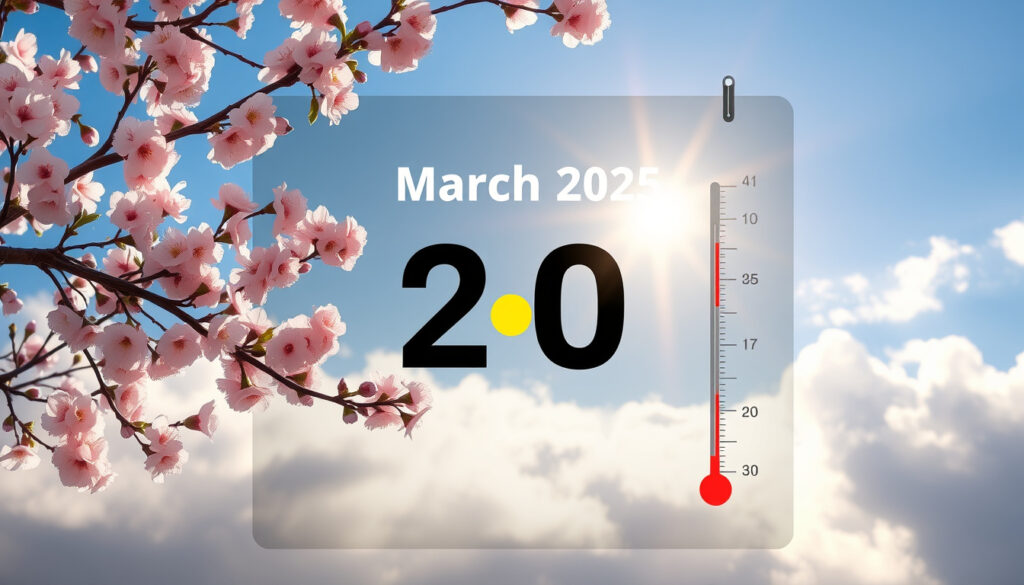
When Does Spring Start 2025? Equinox & Meteorological Dates
A new season often feels like a fresh start — a reason to turn the page, pack away the winter coats, and think about longer days. But if you’ve tried to pin down exactly when spring 2025 begins, you’ve probably noticed conflicting answers. The Met Office (the UK’s national weather service) marks 1 March as the start of meteorological spring, while the Royal Observatory in Greenwich sets the astronomical start at the spring equinox, which in 2025 falls on 20 March. Knowing the difference between the two helps you plan your calendar and understand seasonal forecasts.
Spring equinox 2025 (Northern Hemisphere): March 20, 2025 ·
Meteorological spring start: March 1, 2025 ·
Typical equinox date range: March 19–21 ·
Daylight change at equinox: ~12 hours of day/night
Quick snapshot
- Spring equinox 2025 in the Northern Hemisphere occurs on March 20, 2025 at 09:01 UTC (Royal Museums Greenwich)
- Meteorological spring starts on March 1, 2025 (Met Office)
- Equinox dates vary between March 19 and March 21 each year (Royal Museums Greenwich)
- Whether spring is “early” in 2025 is subjective; the equinox date falls within the normal range (Met Office)
- Exact local time of the equinox depends on your time zone (Royal Museums Greenwich)
- How the equinox time translates to local time in different UK time zones adds confusion (Met Office)
- March 1, 2025 – Meteorological spring begins (Royal Museums Greenwich)
- March 20, 2025 – Spring equinox (astronomical spring starts) (Royal Museums Greenwich)
- June 20, 2025 – Summer solstice (spring ends) (Royal Museums Greenwich)
- After the equinox, days in the Northern Hemisphere get longer than nights (Met Office)
- Spring lasts until the summer solstice on June 20, 2025 (Met Office)
Between the two definitions, a few concrete numbers help keep things clear.
| Fact | Value |
|---|---|
| Spring equinox 2025 (Northern Hemisphere) | March 20, 2025 at 09:01 UTC |
| Meteorological spring start | March 1, 2025 |
| Number of daylight hours at equinox | ~12 hours (nearly equal) |
| Equinox date range (Northern Hemisphere) | March 19 to March 21 |
What day does spring arrive in 2025?
Astronomical spring start date for 2025
- Astronomical spring in the Northern Hemisphere begins at the vernal equinox on March 20, 2025, at 09:01 UTC (Royal Museums Greenwich).
- The equinox is the moment the Sun crosses the celestial equator, making day and night nearly equal in length (Met Office source).
Meteorological spring start date
- Meteorological spring runs from March 1 to May 31, so it begins on March 1, 2025 (Met Office source).
- Meteorologists use fixed three-month seasons to simplify climate records and comparisons across years (AccuWeather source).
For UK gardeners, energy planners, and anyone tracking heating bills, the meteorological definition gives a predictable start date, while the astronomical version aligns with daylight patterns. The trade-off: one sacrifices precision for consistency, the other sacrifices simplicity for astronomical accuracy.
Is March 21 always the first day of spring?
Why equinox dates shift
- The spring equinox usually falls on March 20, but can occur on March 19 or March 21 depending on the year and time zone (Royal Museums Greenwich source).
- The last March 21 equinox in the US was in 2011, and it will not happen again until 2101 (Weather & Radar source).
The range of equinox dates
- The equinox oscillates between March 19 and March 21 because the Earth’s orbit takes about 365.25 days, causing the calendar to slide slightly year to year (Met Office source).
- Leap years pull the date back, so the range remains within three days.
Many calendars still print March 21 as the first day of spring, but that hasn’t been the case for most years since the 20th century. If you rely on the date printed on an old wall calendar, you could be off by a day or more.
The implication: always check the astronomical calculation rather than trusting printed tradition.
Is March 1 officially spring?
Meteorological vs astronomical definitions
- Yes—meteorological spring is officially spring in the world of weather forecasting. The Met Office, AccuWeather, and other major services all treat March 1 as the start (AccuWeather source).
- The system was created because traditional astronomical seasons vary in length from 89 to 93 days, making statistical comparisons inconsistent (AccuWeather source).
Why meteorologists use March 1
- Meteorological seasons divide the year into four three-month periods based on average monthly temperatures and the calendar (Royal Museums Greenwich source).
- This gives climate scientists a stable, repeatable dataset for trends and forecasts.
When does spring start in Ireland and the UK?
Astronomical start in Ireland
- In Ireland, astronomical spring begins on March 20, 2025, the same equinox date as the rest of the Northern Hemisphere (Royal Museums Greenwich source).
- Irish tradition also marks Imbolc on February 1 as the start of Celtic spring, though this is not used in modern calendars.
Meteorological start in the UK
- The UK follows meteorological spring starting March 1 (Met Office source).
- This is the definition used by the Met Office for all seasonal weather outlooks.
Traditional Irish spring (February 1)
- Imbolc, halfway between winter solstice and spring equinox, has long been considered the start of spring in Gaelic tradition. It’s still observed culturally but has no official status in weather or astronomy.
For visitors to Ireland and the UK, the key takeaway: if you see a weather forecast for “spring” in early March, it’s already spring meteorologically. If you’re booking a trip around the equinox, you’ll experience the astronomical season change with nearly equal day and night around March 20.
The pattern across the islands: two definitions coexist, and knowing which one applies to your activity avoids confusion.
Timeline: Spring 2025 at a glance
- March 1, 2025 – Meteorological spring begins (Met Office source).
- March 20, 2025 – Spring equinox (astronomical spring starts) at 09:01 UTC (Royal Museums Greenwich source).
- June 20, 2025 – Summer solstice (astronomical spring ends) (Royal Museums Greenwich source).
The sequence is fixed: meteorological spring kicks off the season a few weeks before the astronomical equinox.
What the experts say
The spring equinox marks the start of spring astronomically. In 2025 the spring equinox falls on 20 March.
— Royal Museums Greenwich (source)
Meteorological spring begins on 1 March each year and is based on the annual temperature cycle.
— Met Office (source)
For anyone planning travel, planting, or simply marking the change of season, the choice between March 1 and March 20 depends on what you need. Weather forecasters work with March 1; astronomers and many cultural traditions stick with the equinox. The implication for British and Irish readers is clear: if you want consistency, go meteorological. If you want the moment day and night balance, mark March 20 on your calendar.
Frequently asked questions
Why does the date of spring change each year?
The spring equinox shifts because the Earth’s orbit takes about 365.25 days, so the calendar and astronomical events slide slightly year to year. Leap years help reset the alignment.
How is the spring equinox calculated?
The equinox is the moment the Sun crosses the celestial equator from south to north. It is calculated using precise astronomical models and occurs at a specific UTC time each year (Met Office source).
What is the difference between astronomical and meteorological seasons?
Astronomical seasons are based on Earth’s position relative to the Sun (equinoxes and solstices). Meteorological seasons are fixed three-month blocks that simplify climate statistics (AccuWeather source).
Does spring start on the same day everywhere in the world?
No. The astronomical equinox occurs at the same moment globally, but local time zones mean the calendar date varies. The Southern Hemisphere experiences autumn at that time.
When is the first day of spring in the Southern Hemisphere?
The Southern Hemisphere’s spring equinox occurs around September 22 each year, opposite to the Northern Hemisphere’s spring.
What happens during the spring equinox?
Day and night are nearly equal in length (about 12 hours each). After the equinox, days become longer than nights in the Northern Hemisphere (Met Office source).
For related date events, see National Cheeseburger Day 2025 and the 30 C to F conversion guide.
More related posts
 Best Christmas Gifts for Men: Ireland’s Top Retailer Picks
 Hint for Wordle Today: Clues for Puzzle #1851
 Atlético Madrid vs Rayo Vallecano: H2H, Predictions & More
 How to Scan on iPhone: Documents, QR Codes & More Guide
 How to Descale Keurig: Vinegar & Solution Guide
 Something About Her Sandwich Shop: Menu & Reviews (2026)
 Best Microphones for Podcasting 2026: Top Picks & Guide